Serial Number
Serial Number Allocation
Serial number allocation refers to the systematic process of assigning a unique identifier—known as a serial number—to each individual item, product, or record within a system. These serial numbers are typically generated in an incremental or sequential manner to ensure uniqueness and traceability.
A serial number serves as a distinct reference that differentiates one item from another, even if the items are otherwise identical in terms of type, model, or specification. This is particularly useful in manufacturing, inventory management, software licensing, warranty tracking, and asset management.
The allocation process typically follows one of the following approaches:
Sequential Allocation: Serial numbers are assigned in a fixed order (e.g., 10001, 10002, 10003...), making it easy to determine the order in which items were created or processed.
Grouped or Block Allocation: Serial numbers may be pre-allocated in blocks for use by different systems or departments to avoid duplication in distributed environments.
Custom Patterns: In some systems, serial numbers include date codes, product codes, or location identifiers for better classification and tracking.
Proper serial number allocation ensures:
Data integrity: Each item can be uniquely identified and tracked throughout its lifecycle.
Auditability: Enables easy tracking for quality control, compliance, and support purposes.
Efficiency: Reduces errors in inventory and record-keeping systems.
In conclusion, serial number allocation is a critical component in any system that requires precise tracking, historical record-keeping, or warranty and service management..
Serial Number Allocation in AbacuX In our ERP application, Serial Number Allocation is a crucial process for tracking and identifying individual items throughout their lifecycle. It is applied based on the source of the item—whether it is purchased, part of the opening stock, or manufactured internally. The system supports three types of serial number allocations:
Purchase Serial Allocation
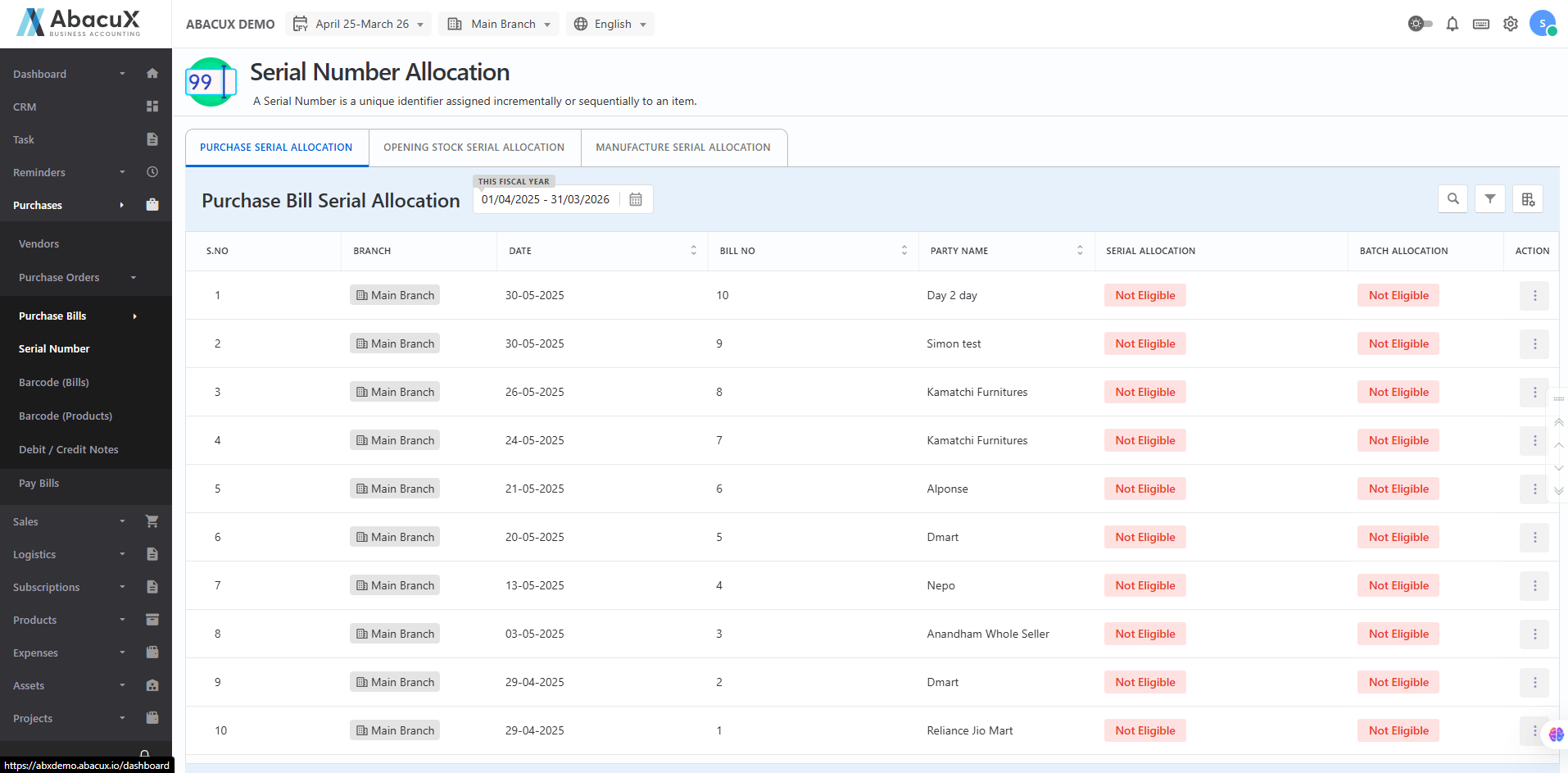
Purpose: To assign serial numbers to items received through purchase transactions.
Description: When an item is purchased and the "Serial Product" option is enabled for that item, it becomes eligible for serial number allocation. The system lists all such items under the Purchase Serial Allocation section, allowing users to assign unique serial numbers to each unit received.
Key Points:
-
Only items marked as "serial-enabled" during purchase are eligible.
-
Serial numbers must be assigned at the time of receiving or shortly after.
-
This ensures traceability from the point of procurement to end-use or sale.
Opening Stock Serial Allocation
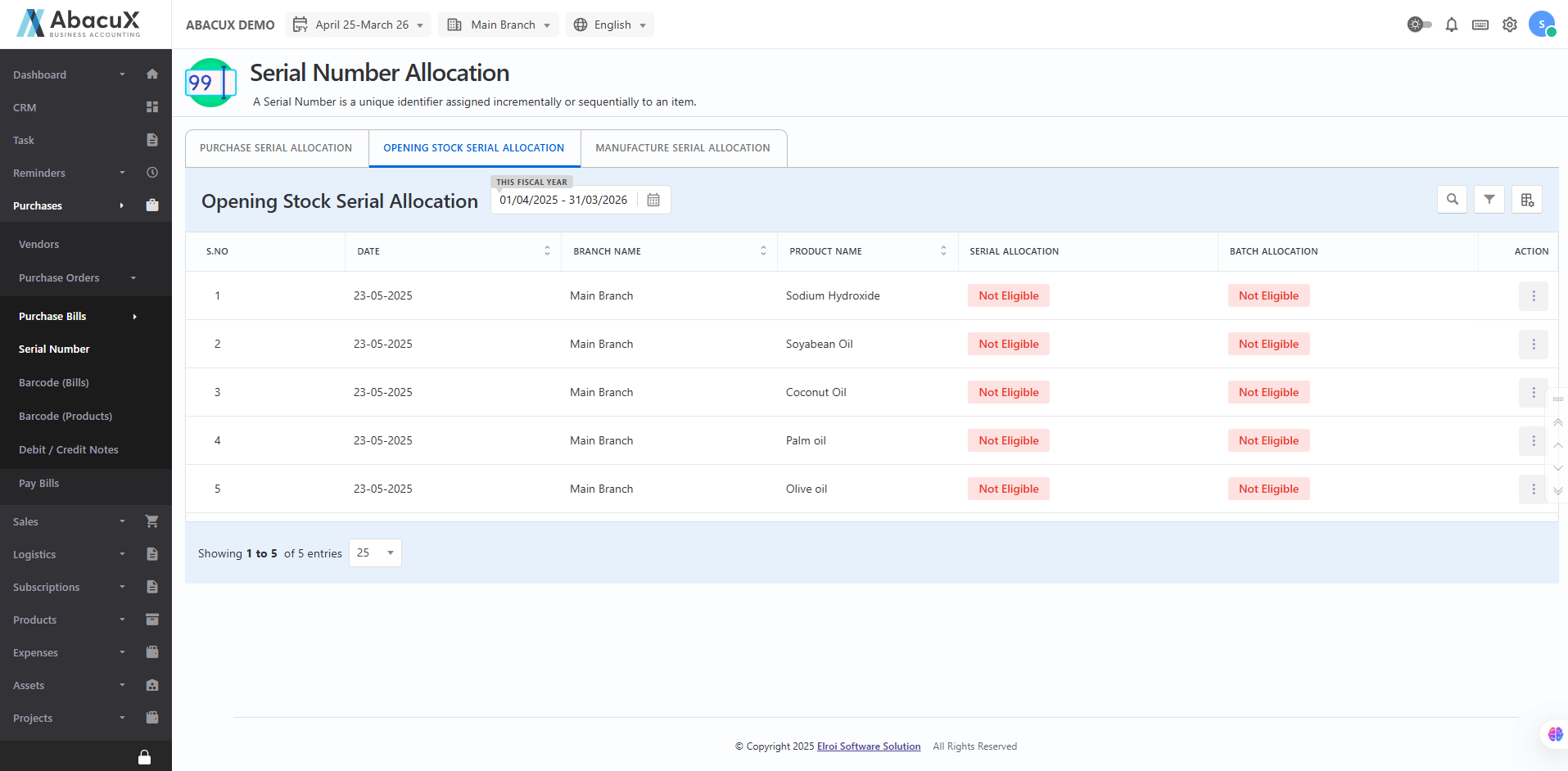
Purpose: To assign serial numbers to existing stock items when transitioning to the ERP system or initializing inventory.
Description: Opening stock refers to the inventory already available in the organization at the time of starting with the ERP system. For serial-enabled items in the opening stock, serial numbers can be allocated using the Opening Stock Serial Allocation module.
Key Points:
-
Helps in initializing the serial tracking system accurately.
-
Only applicable to items flagged as serial-enabled in the master settings.
-
Ensures proper continuity and historical traceability even for pre-ERP stock.
Manufacture Serial Allocation
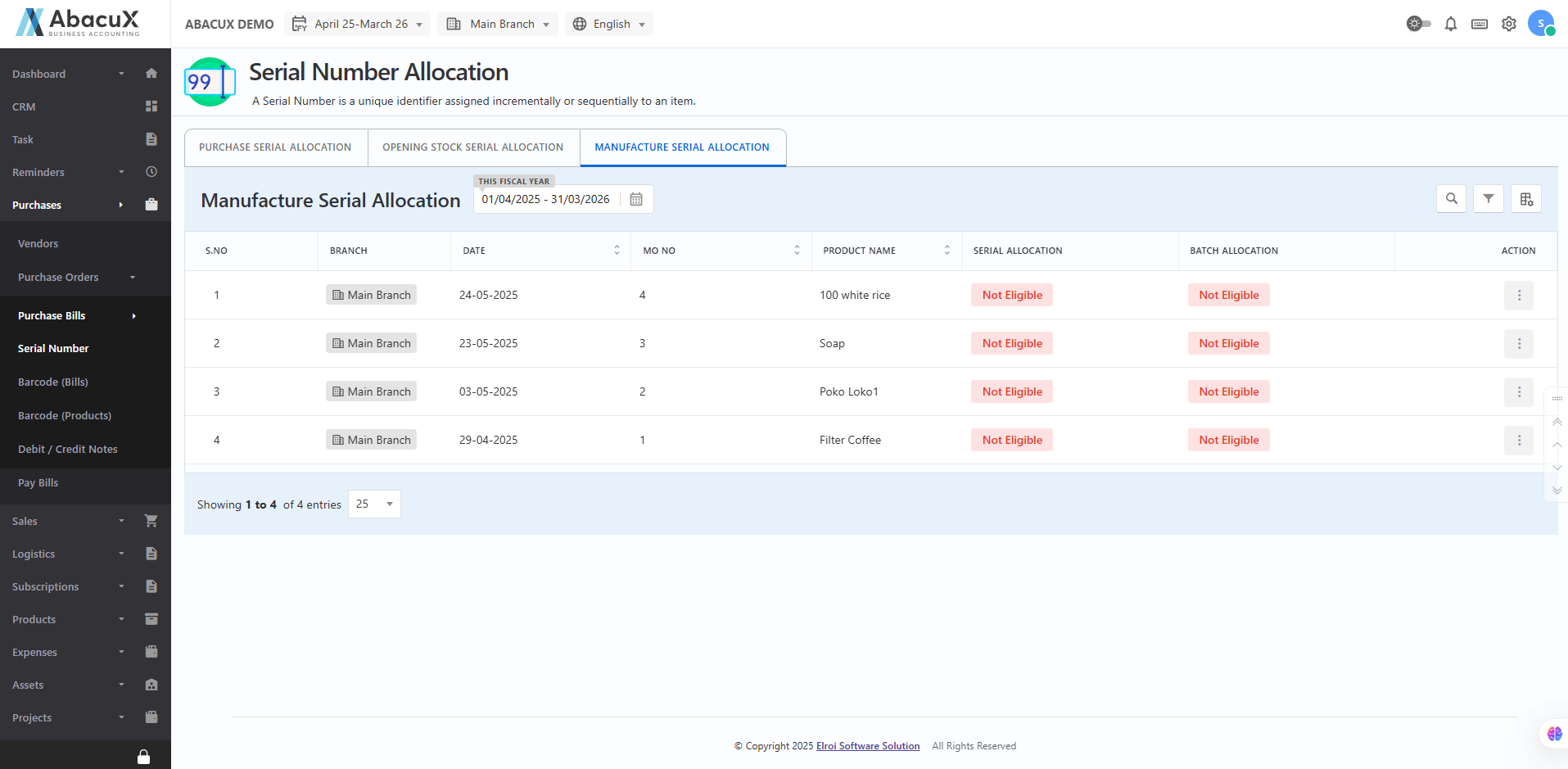
Purpose: To assign serial numbers to newly manufactured items.
Description: When a product is manufactured internally and is defined as a serial-enabled item in the product master, the system will prompt the user to allocate serial numbers to each unit produced. This ensures that all internally manufactured serial products are traceable post-production.
Key Points:
-
Only applicable to serial-enabled manufactured products.
-
Serial number allocation can be done immediately after production or during the stock transfer process.
-
Vital for internal quality control, maintenance, and warranty tracking.