Account Journal
Account Journal
The Account Journal is a critical component of the accounting module in the ERP system. It serves as the primary record for all financial transactions that affect the general ledger. Each transaction recorded in the journal includes detailed information such as the date, reference number, account debited or credited, description, and the respective amounts.
The Account Journal helps maintain an audit trail of all entries, ensuring transparency, accuracy, and traceability in financial reporting.
Key Features:
Transaction Recording:
- Every financial transaction is first recorded in the journal before being posted to the general ledger.
Debit & Credit Entries:
- Each journal entry contains both debit and credit information as per the double-entry accounting system.
Manual and Automated Entries:
- Journals can be created manually for specific adjustments or posted automatically through integrated modules like Sales, Purchase, Expense, and Payments.
Filtering and Search:
- Users can filter journal entries based on date, reference number, account type, or status for easier tracking and review.
Audit Trail:
- Each entry is time-stamped and user-tagged to maintain a secure and auditable record of all accounting operations.
Reversals and Corrections:
- Journal entries can be reversed or corrected through proper authorization, maintaining data integrity.
Benefits:
-
Enhances financial accuracy and consistency
-
Enables detailed reporting for audits and financial reviews
-
Helps in reconciling and validating ledger balances
-
Supports compliance with accounting standards
Manage Account Journals
- Navigate to the Account Journal section under the Accounts menu to view the list of journal entries.
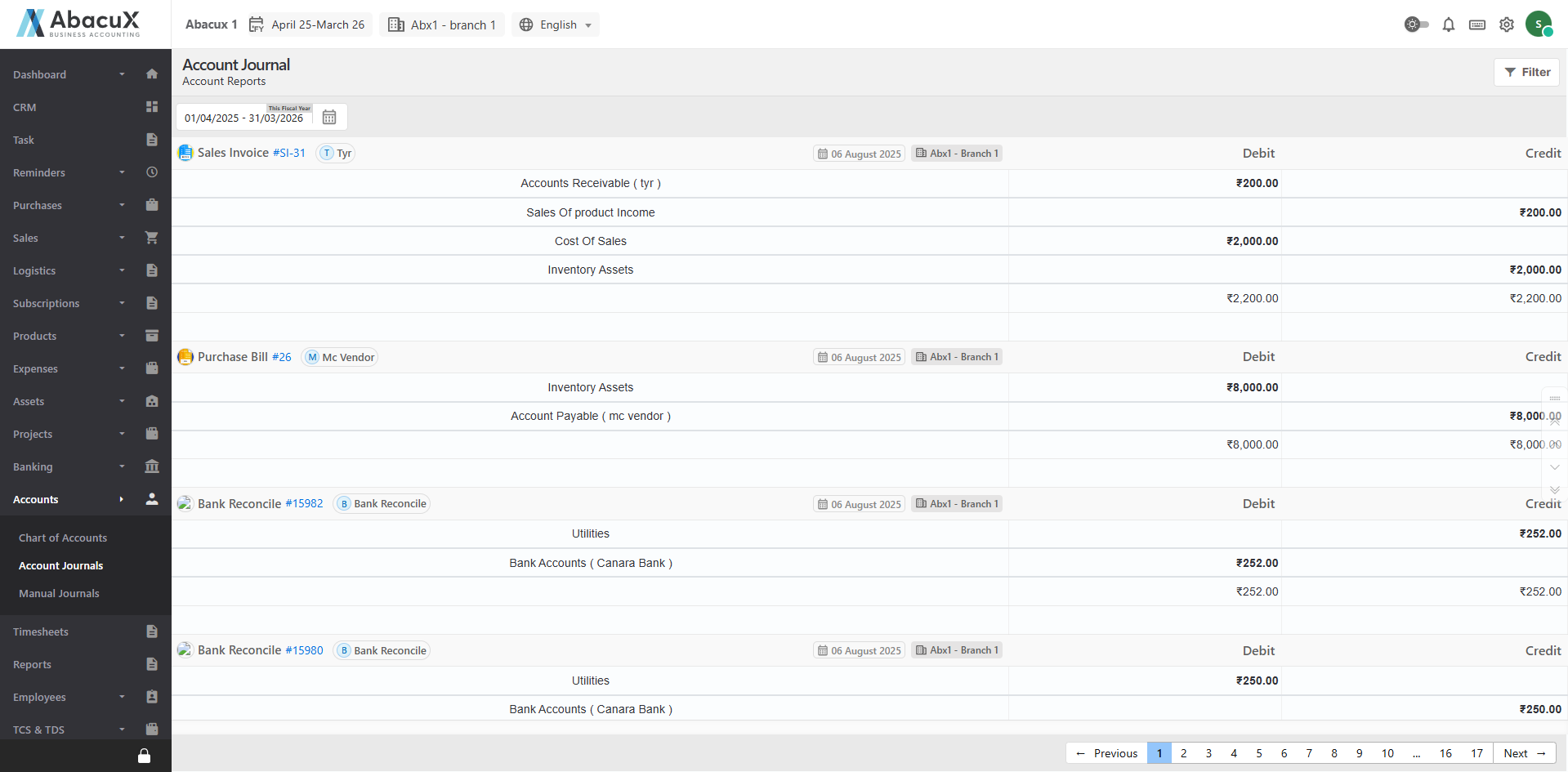
-
The journal entries are automatically generated based on various transactions performed within the ERP system, such as Sales, Purchases, Payments, and other accounting activities.
-
You can click on any journal entry in the list to view its detailed information, including the associated ledger accounts, debit and credit amounts, transaction reference, and date.